


















 Back to List
Ask HJT | What Sets Dinto Solar’s HJT 1/3-Cut Modules Apart?


1/3-cut technology is becoming an important pathway for high-efficiency HJT modules. However, selecting the optimal cell-cutting architecture requires a balance between power gain, manufacturing yield, reliability, and customer value. In this episode of Ask HJT, we explore why Dinto Solar selected 1/3-cut technology for its next-generation HJT modules, and how it compares with both conventional half-cut and finer multi-cut designs.

Q1: Why is 1/3-cut considered the optimal architecture for next-generation high-power HJT modules?
A. Half-cut has lower material utilization, while 1/4-cut requires higher equipment investment.
B. Half-cut offers limited power gains, while 1/4-cut increases manufacturing challenges.
C. Half-cut cannot meet high-efficiency requirements, while 1/4-cut lacks reliability validation.
D. Half-cut is unsuitable for large wafers, while 1/4-cut is incompatible with existing production lines.
Performance Balance
Cell cutting is a trade-off between electrical performance and manufacturing reliability. Half-cut technology delivers limited additional gains as module power increases, while 1/4-cut introduces greater mechanical stress and yield challenges.
With an approximately 70 mm cell strip width, Dinto Solar’s 1/3-cut design achieves an optimal balance between lower electrical losses, production stability, and energy output.
✅Correct answer to Q1: B
Q2: Why does 1/3-cut combined with 0BB create a “1+1>2” effect?
A. 1/3-cut reduces current, while 0BB lowers electrical losses.
B. 1/3-cut increases module size, while 0BB improves light absorption.
C. 1/3-cut simplifies production, while 0BB reduces silver consumption.
D. 1/3-cut improves low-light performance, while 0BB increases bifaciality.
Loss Reduction
The synergy between 1/3-cut and 0BB lies in reducing electrical losses at both the cell and interconnection levels. 1/3-cut lowers cell string current to around one-third, reducing I²R (resistive) losses, while 0BB eliminates conventional busbars and shortens current collection paths to reduce series resistance.
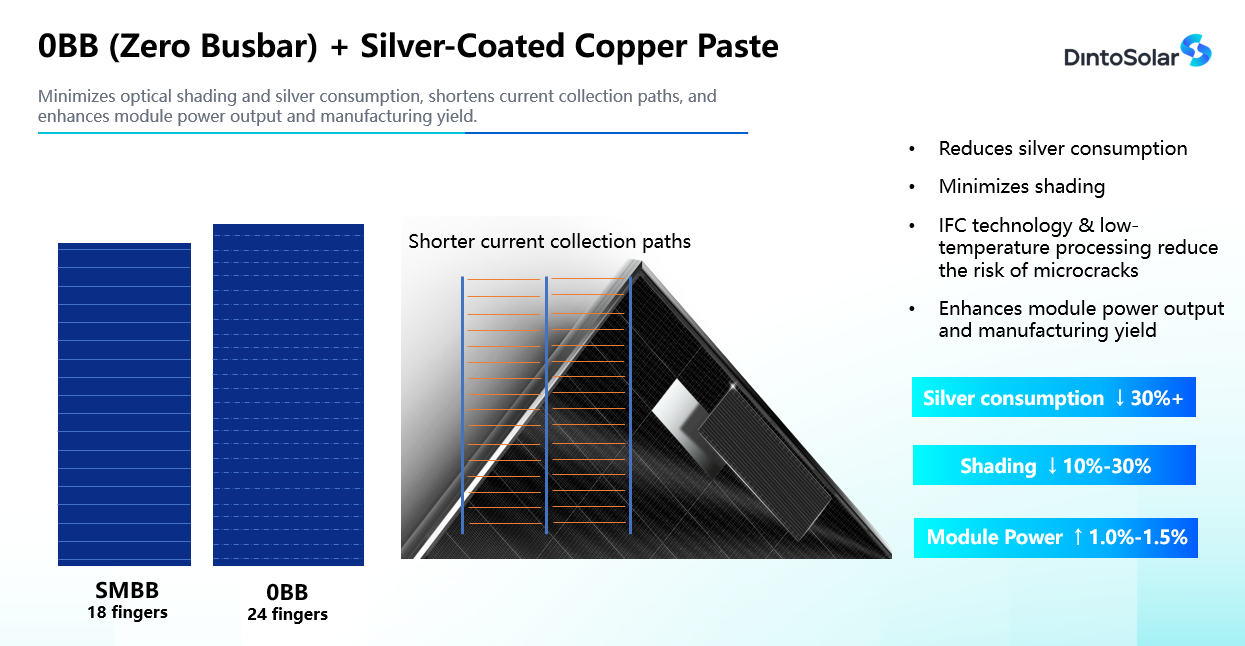
Together, the two technologies improve fill factor and module output, delivering approximately 30 W higher power than conventional half-cut modules while reducing hotspot risks.
✅Correct answer to Q2: A
Q3: Why can 1/3-cut modules reduce hotspot risks and improve long-term reliability?
A. Smaller cells provide a larger heat dissipation area.
B. Lower string current reduces heat generation, while narrower cell strips improve heat distribution.
C. Additional thermal materials improve module cooling performance.
D. Thinner wafers accelerate heat transfer.
Output Stabilization
During partial shading, hotspot risk is closely linked to current flow, as heat generation increases with the square of current. By reducing string current to one-third of conventional designs, 1/3-cut modules significantly lower localized heating. The narrower cell strips further improve heat distribution, helping mitigate hotspot formation. Lower operating temperatures reduce power losses and degradation, extending module lifetime.
✅Correct answer to Q3: B
Q4: What value can Dinto Solar’s 1/3-cut modules deliver for project owners? (Multiple answers)
A. Higher module output and increased energy generation.
B. More stable performance in high-temperature environments.
C. Flexible deployment across residential, C&I, and utility-scale projects.
D. Direct reduction of required inverter capacity.
Value Maximization
The value of 1/3-cut technology is ultimately reflected in project performance:
· Lower current reduces internal losses and improves energy yield.
·Improved thermal performance reduces hotspot risks and supports long-term reliability.
·Multiple module formats enable flexible application across different project scenarios.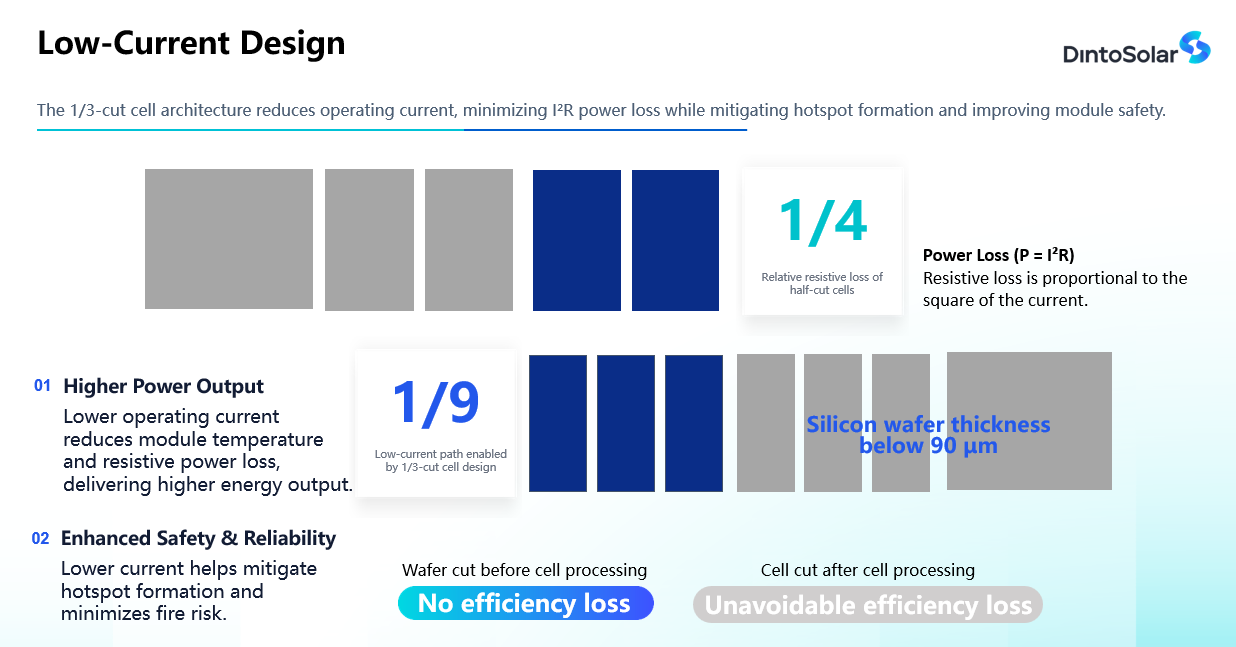
✅Correct answer to Q4: A, B, C
1/3-cut technology goes beyond simply cutting cells—it represents a new approach to balancing power output, reliability, and project value. With higher power density, improved thermal performance, and flexible module formats, Dinto Solar’s 1/3-cut HJT modules help customers achieve greater energy yield and operational efficiency across a wide range of applications.
We welcome you to share your own insights on heterojunction technology or let us know which HJT questions you would like us to explore next. Selected topics will be featured in future installments of Ask HJT.