















 Back to List
Ask HJT | Where Does HJT’s Heat-Resistant “DNA” Come From?


As temperatures climb during the peak of summer, abundant sunshine can also create a challenge for PV modules. When modules operate for extended periods under high temperatures and intense irradiance, rising cell temperatures do more than create harsher operating conditions. They also trigger a series of internal losses—lower voltage, greater carrier losses, and increased interface recombination—that ultimately affect a solar plant’s long-term returns.
For projects in hot, high-irradiance regions, a module’s ability to maintain stable output under intense sunlight is becoming an important measure of high-efficiency technology. In this episode of Dinto Solar’s Ask HJT, we explore how HJT activates its heat-resistant “DNA” to maintain energy yield in high-temperature environments.
Q1: Why do high temperatures reduce PV module power output?
A. High temperatures reduce solar irradiance and therefore lower light input.
B. High temperatures increase internal semiconductor losses, reducing voltage and increasing carrier losses.
C. High temperatures reduce the transmittance of module glass.
D. High temperatures prevent silicon from absorbing sunlight.
Structural Temperature Control
High-temperature losses in PV modules do not originate from the external environment itself; they arise from changes in the semiconductor state inside the cell. As cell temperature rises, the intrinsic carrier concentration and dark saturation current increase, causing open-circuit voltage (Voc) to decrease. Changes in carrier transport and recombination can also affect fill factor, resulting in an overall reduction in maximum power output. The key to high-temperature performance is therefore not simply the heat resistance of encapsulation materials, but whether the cell structure can effectively control internal losses.
✅ Correct answer to Q1: B
Q2: Why do different PV technology routes perform differently under the same high-temperature conditions?
A. Different cell structures vary in their ability to control temperature-induced internal losses.
B. Different technologies use different module colors, resulting in different levels of heat absorption.
C. Different encapsulation thicknesses determine a module’s heat resistance.
D. Different installation methods alter the electronic transport properties of silicon.
Heterojunction Loss Reduction
The performance differences among PV technology routes at high temperatures fundamentally stem from differences in cell architecture, passivation quality, and carrier transport.
Conventional crystalline silicon cells rely on homojunction architectures, while HJT combines crystalline silicon with hydrogenated amorphous silicon layers to form carrier-selective heterojunction contacts. The resulting band alignment, together with excellent interface passivation, helps suppress recombination and supports a high open-circuit voltage (Voc). Because voltage loss is the dominant contributor to declining solar-cell efficiency as temperature rises, HJT’s high Voc and low recombination losses help limit the reduction in power output under high-temperature conditions.
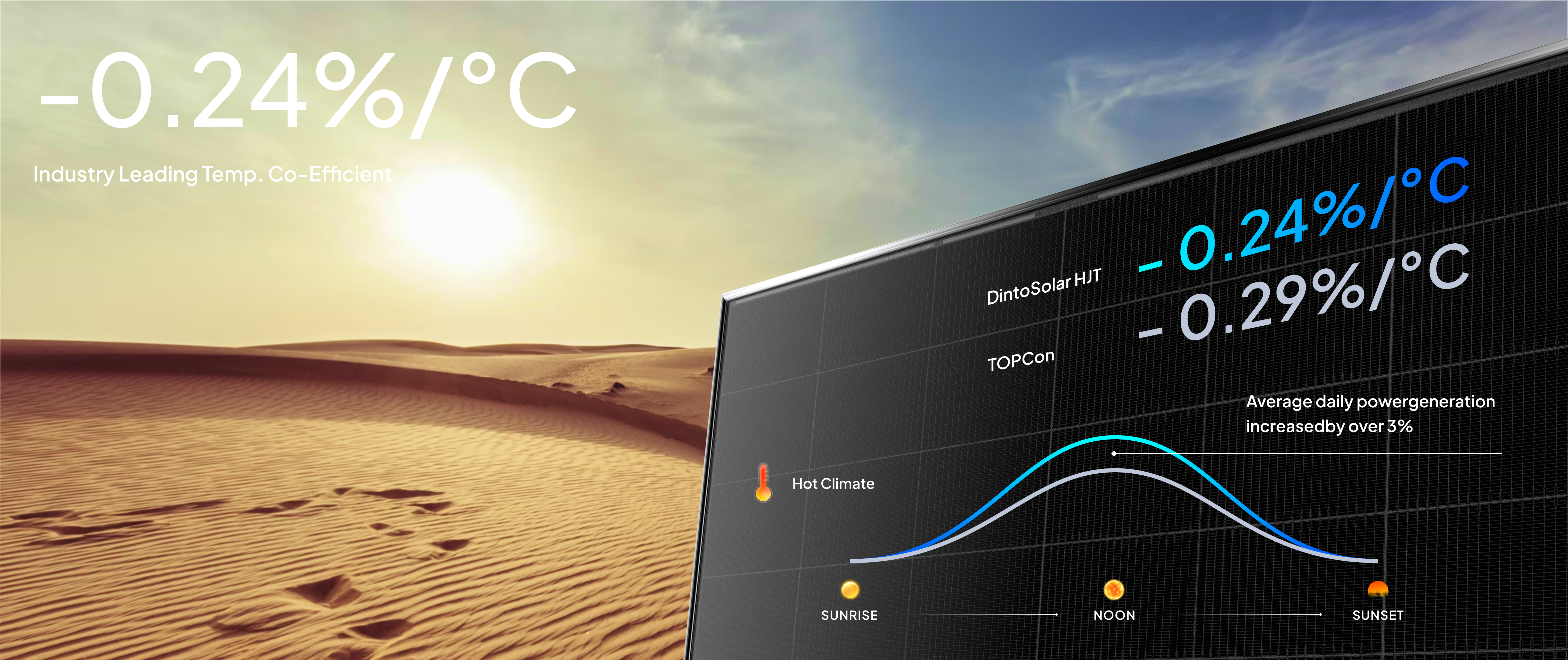
This is an important reason why Dinto Solar’s HJT modules achieve a superior temperature coefficient of −0.24%/°C, supporting stronger power retention in hot operating environments.
✅ Correct answer to Q2: A
Q3: How does HJT’s intrinsic amorphous silicon passivation layer reduce high-temperature recombination losses?
A. It increases glass transmittance and improves light absorption.
B. It reduces interface defects and carrier recombination losses.
C. It increases cell thickness and improves mechanical strength.
D. It replaces all conductive materials and eliminates all electrical resistance.
Interface Passivation
In semiconductor devices, interface defects are a major source of carrier loss. A defining feature of HJT is the intrinsic amorphous silicon passivation layer introduced between the crystalline silicon substrate and the doped amorphous silicon emitter. Hydrogen atoms in the intrinsic a-Si:H layer passivate dangling bonds at the crystalline-silicon surface, significantly reducing interface defect density and carrier recombination. This excellent surface passivation is one of the key reasons HJT cells can achieve high Voc and maintain strong electrical performance as operating temperature rises.
✅ Correct answer to Q3: B
Q4: Beyond the temperature coefficient, which HJT processes jointly support long-term energy yield in high-temperature environments? (Multiple answers)
A. Low-temperature manufacturing reduces thermal damage to the silicon substrate.
B. The heterojunction structure reduces the impact of dark current.
C. High-quality passivation reduces interface recombination.
D. The transparent conductive oxide (TCO) layer supports efficient carrier collection and transport.
System-Level Synergy
HJT’s high-temperature performance is not determined by a single technology. It results from a system of capabilities spanning materials, cell structure, and manufacturing processes.
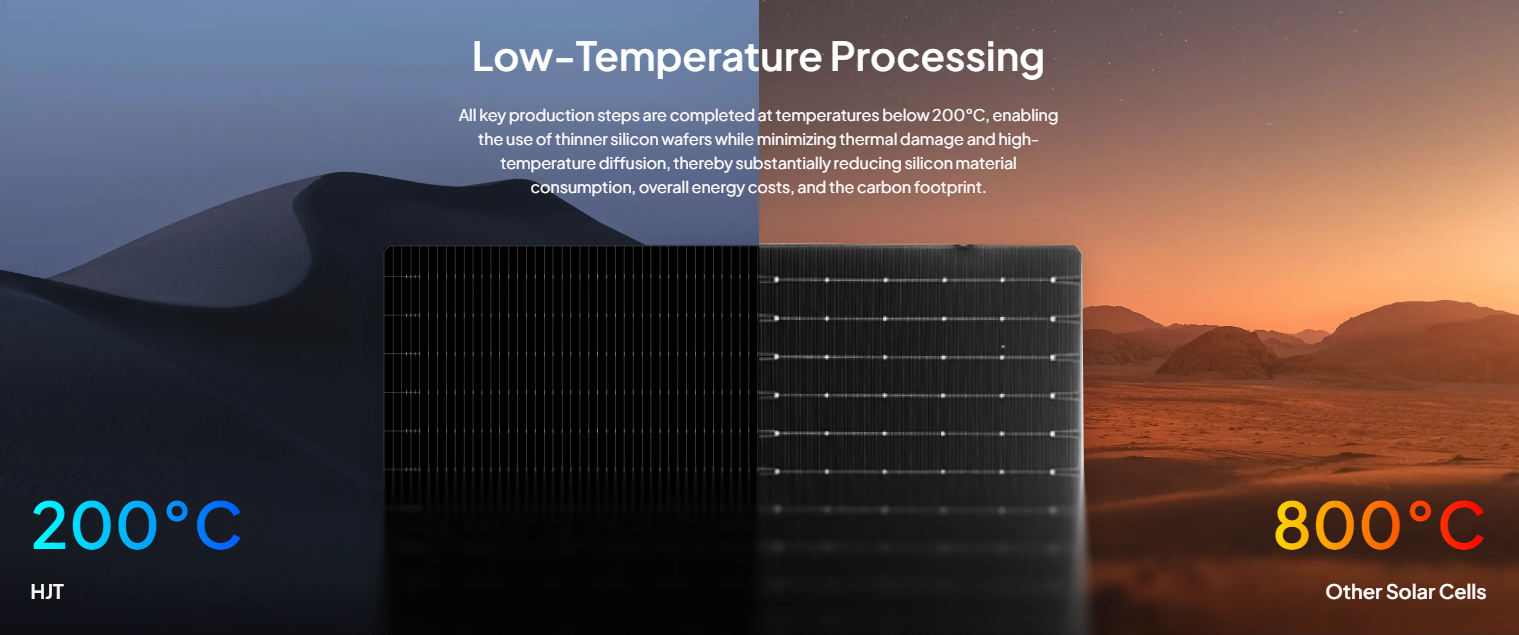
On the manufacturing side, HJT uses low-temperature deposition, with the overall process temperature kept below 200°C. This avoids the material damage that can occur during conventional high-temperature diffusion and reduces internal defects in the silicon substrate. HJT also uses transparent conductive oxide (TCO) layers to support efficient lateral carrier transport and current collection while maintaining optical transparency.
From the band offset created by the heterojunction structure, to intrinsic amorphous silicon passivation, to the low-temperature manufacturing route, these technologies work together to reduce internal losses at high temperatures and maintain more stable power output.
✅Correct answers to Q4: A, B, C, D
Truly advanced technology is not defined by setting peak records under ideal conditions, but by protecting long-term value under extreme conditions. HJT’s heat-resistant “DNA” comes from the heterojunction structure’s precise control of semiconductor loss mechanisms. By reducing voltage loss and carrier recombination at high temperatures, HJT converts more of every ray of intense sunlight into energy yield.
With a superior temperature coefficient, lower high-temperature losses, and more stable output, Dinto Solar’s HJT technology provides a high-value, full-life cycle solution for hot, high-irradiance environments.
We welcome you to share your own insights on heterojunction technology or let us know which HJT questions you would like us to explore next. Selected topics will be featured in future installments of Ask HJT.