












 Back to List
MESIA: Spotlight on Yang Zongyuan, Vice President, Dinto Solar


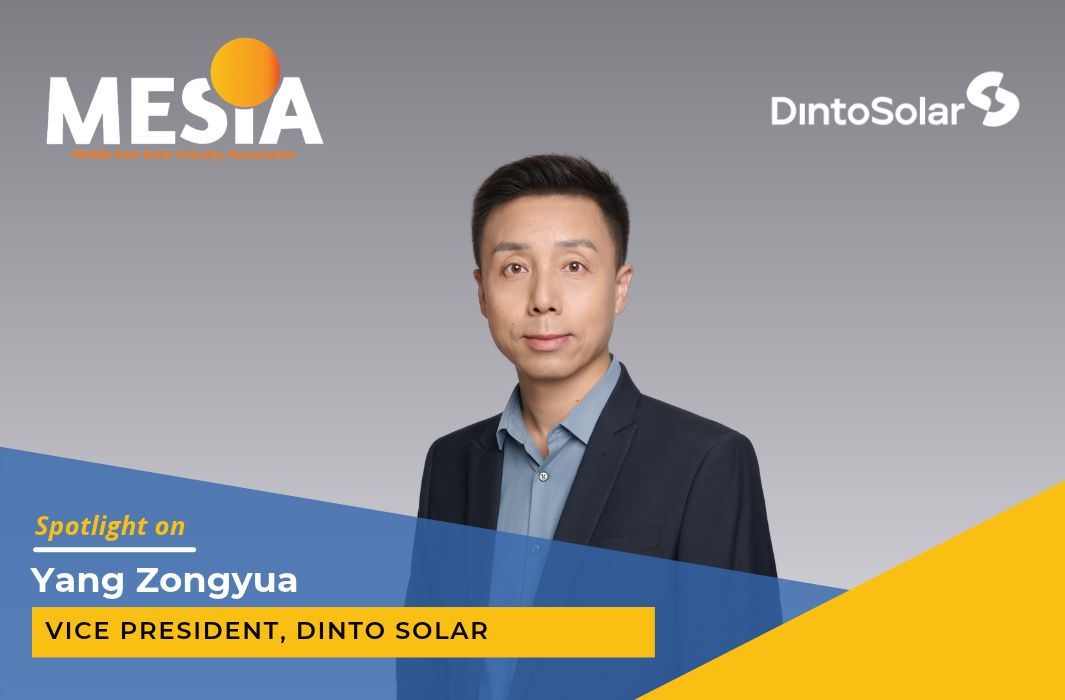
About Yang Zongyuan
Yang Zongyuan is Vice President of Dinto Solar and a solar industry executive with more than a decade of experience across the photovoltaic value chain, from mounting systems and module commercialization to project development. He brings extensive expertise in global sales and marketing, brand building, and strategic market expansion. An early advocate for heterojunction (HJT) technology, he has helped advance its large-scale adoption in China and international markets, including major procurement programmes and projects led by prominent state-owned energy groups. He has led teams in delivering more than 10 GW of HJT products and related services to customers worldwide.
Please describe your role at Dinto Solar as well as your industry expertise.
As Vice President of Dinto Solar, I lead the company’s global sales and marketing, brand strategy, and market development. My responsibility is to connect our technology roadmap with what customers and projects actually need: dependable energy yield, competitive lifetime economics, reliable quality, and responsive local support.
I work closely with our R&D, manufacturing, and regional teams, as well as developers, EPC companies, distributors, and other partners, to translate project conditions into the right product and service solutions. My expertise lies in commercializing advanced PV technologies across different markets and building long-term partnerships. At Dinto Solar, I lead our team in promoting HJT technology and helping customers better understand its technical advantages and long-term value, while supporting its large-scale deployment in demanding markets such as the Middle East and North Africa.
What motivated Dinto Solar to invest in the MENA’s solar industry?
The MENA region combines exceptional solar resources with ambitious energy-transition and economic-diversification goals. It is therefore not simply a high-growth market, but a region where advanced solar technology can create significant long-term value.
At the same time, high temperatures, intense irradiance, dust, and large daily temperature variations place demanding requirements on module performance and durability. HJT is particularly well suited to these conditions because of its superior temperature coefficient, high bifaciality, and low degradation.
Dinto Solar aims to contribute to the region’s energy transition by providing advanced HJT solutions that deliver more energy throughout the full project lifecycle at an increasingly affordable cost. Through technological innovation, manufacturing optimization, and economies of scale, we seek to reduce costs and enable the wider adoption of sustainable energy. Our decision to join MESIA reflects this commitment to local collaboration and a cleaner, more resilient energy future.
Can you tell us about what sets you apart from other competitors?
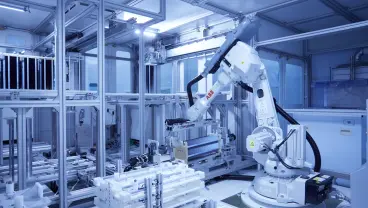
Dinto Solar has remained focused on HJT technology for nearly a decade, building strong expertise in R&D, industrialization, and large-scale manufacturing. We have proprietary mass-production capabilities for both silver-metallized and copper-metallized HJT technologies, supported by more than 120 patents.
HJT is particularly well suited to the MENA region’s high-temperature and high-irradiance conditions. Its excellent temperature coefficient of -0.24%/°C means lower power loss as module temperatures rise, enabling more stable performance and greater energy generation in hot climates. High bifaciality and low long-term degradation further improve lifetime energy yield. Our latest modules deliver up to 770 W with 24.8% efficiency.
HJT also features a streamlined four-step, low-temperature production process with a lower carbon footprint. Its compatibility with copper metallization and perovskite-silicon tandem architectures makes it a future-ready platform with the potential to move beyond the efficiency limits of conventional single-junction crystalline-silicon technology.
What’s a recent milestone Dinto Solar has achieved that you would like to share with us?
One recent milestone particularly relevant to MENA was our 20 MW distribution agreement in Egypt for 740 W G12-132 HJT modules. The modules are intended for desert solar-powered water pumping and distributed PV projects, supporting agricultural irrigation and off-grid power requirements. This is a meaningful example of advanced PV technology serving both the energy transition and local communities.
To meet the requirements of large-scale utility projects, we have also developed high-power, high-efficiency modules designed to deliver greater energy yield and improve overall project economics, particularly under hot desert conditions.
Meanwhile, joining MESIA enables us to deepen our engagement with regional developers, EPCs, investors, and other stakeholders. Together, these developments reflect our progress in building local distribution, market access, and project-specific capabilities across MENA.
What are your expectations for the MENA region in terms of growth and new opportunities for Dinto Solar?
We expect MENA to remain one of the world’s most important solar growth regions. Utility-scale projects will continue to expand, but we also see significant opportunities in commercial and industrial rooftops, distributed generation, solar-powered water applications, and other solutions that improve energy access and efficiency.
Saudi Arabia and the UAE are setting the pace through ambitious national transition programmes, while North Africa offers considerable potential through its solar resources, growing electricity demand, and proximity to major energy markets.
Success, however, will require more than supplying modules. Manufacturers must provide high-efficiency technology, localized technical support, dependable delivery, and products designed for desert conditions. Dinto Solar plans to work through strong regional partnerships and its expanding distribution network to offer competitive HJT solutions that support lower lifetime energy costs and sustainable economic development.
How do you see the effects of the increasing adoption of solar energy on the MENA’s economy in the coming years?
Greater adoption of solar energy can generate value across the MENA economy. It can improve energy security, reduce exposure to fuel-price volatility, and free more conventional energy resources for higher-value uses or export. Competitive renewable electricity can also support industrial growth, digital infrastructure, water treatment, and emerging sectors such as green hydrogen.
The solar value chain creates opportunities in engineering, construction, operations, maintenance, distribution, and technical training, helping develop local capabilities and skilled employment. For communities, reliable clean power can support agriculture, small businesses, and essential services, including in areas where grid access is limited.
Environmentally, replacing fossil-based generation reduces emissions and air pollution while conserving resources for future generations. The strongest impact will come when solar deployment is combined with grid modernization, energy storage, local partnerships, and workforce development
Is there something you want to add?
My message to developers, EPCs, investors, and other stakeholders is to assess solar technology by its lifetime value, not only by its upfront price or nameplate wattage. In MENA’s demanding climate, temperature performance, bifacial energy gain, degradation, reliability, and local technical support can materially affect a project’s energy yield and LCOE over 25 to 30 years.
HJT provides a strong platform for meeting these requirements, and its advantages become even more valuable as projects move into harsher or more space-constrained applications. Dinto Solar is ready to collaborate from the early stages of project design, understand local operating conditions, and provide the most appropriate solution.
Through MESIA and our regional partners, we look forward to building long-term relationships and contributing to a solar market that is competitive, resilient, and beneficial to communities across the region.
About Dinto Solar
Dinto Solar Co., Ltd. is a China National-Level High-Tech Enterprise specializing in the R&D, manufacturing, and commercialization of high-efficiency n-type heterojunction (HJT) solar cells and modules. Established in 2017 by the Central Research Institute of State Power Investment Corporation (SPIC), the company has developed integrated R&D and manufacturing capabilities and a planned HJT production footprint of 15 GW. Dinto Solar develops both silver-metallized and copper-metallized HJT technologies and has supported more than 100 projects across diverse applications. Through continuous innovation, reliable products, and local partnerships, Dinto Solar aims to make clean energy more productive, affordable, and sustainable worldwide.
Source: MESIA