



















 Back to List
Ask HJT | Why Heterojunction Solar Earns the Title “King of Bifaciality”


In real-world photovoltaic power plants, energy yield is one of the most important metrics that ultimately determines project value. When bifacial power generation comes into focus, one parameter quietly becomes decisive: bifaciality. It defines how effectively a module converts rear-side irradiation into usable electricity and has increasingly become a key battleground for long-term project returns.
In the second installment of Dinto Solar's Ask HJT series, we address a question that frequently arises in real project discussions:
The Foundation of Leadership: Symmetry by Design
What is bifaciality?
Bifaciality measures a module’s ability to generate power from its rear side. Under Standard Test Conditions (STC), it is defined as the ratio of rear-side to front-side maximum power output:
Bifaciality (%) = Rear-side Pmax / Front-side Pmax × 100%

A higher bifaciality value indicates stronger rear-side photoelectric conversion capability and greater potential for additional energy yield in real operating environments.
Why HJT excels—by structure, not by add-ons
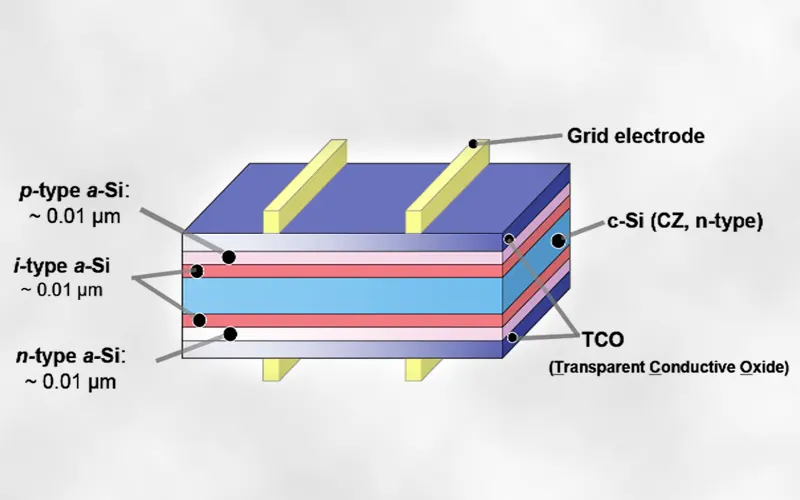
The exceptional bifaciality of HJT modules is not the result of secondary optimization or auxiliary design measures, but rather a direct consequence of their intrinsically symmetrical cell structure.
HJT cells are built on an n-type crystalline silicon wafer with identical functional layers deposited on both sides. Intrinsic amorphous silicon, doped amorphous silicon layers, and transparent conductive oxide (TCO) films are symmetrically applied to the front and rear surfaces. This structural symmetry ensures that the photoelectric conversion mechanisms—and conversion efficiencies—of both sides are nearly identical.
Because the rear side is not a compromised or simplified version of the front, HJT cells naturally achieve very high bifaciality without trade-offs. This symmetry-by-design is what firmly establishes heterojunction technology as the industry’s “King of Bifaciality.”
Proven at scale
At Dinto Solar, mass-produced HJT modules consistently achieve a bifaciality of 90% ±5%, delivering tangible and bankable energy gains at the power plant level.
In contrast, most conventional PV cell technologies rely on inherently asymmetric structures. This structural imbalance fundamentally limits rear-side light utilization, making it difficult for their bifaciality to sustainably exceed the ~90% threshold in large-scale production.
✅ Correct answer to Q1: B
Once the structural advantage is clear, a more practical question naturally follows: In real and complex operating environments, how much value does ultra-high bifaciality actually deliver?
Ultra-high bifaciality translates into real energy—and real returns
The true value of HJT’s leadership in bifaciality lies in its ability to convert often-overlooked environmental light into measurable electricity output:
- A yield amplifier in high-albedo environments: In sand, snow, concrete, and other highly reflective settings, HJT modules can fully exploit rear-side reflected light, delivering meaningful incremental energy gains across the entire power plant.
- An effective collector under diffuse-light conditions: During cloudy days, hazy weather, early mornings, and late afternoons—when irradiation is dominated by diffuse light from multiple directions—HJT modules benefit from their near-equal front and rear photo-response. This allows them to capture ambient light omnidirectionally, enabling earlier start-up in the morning and extended generation into the evening, effectively lengthening daily production hours.
Thanks to their inherent structural symmetry, heterojunction modules have rightfully earned their position as the industry’s “King of Bifaciality.” This built-in advantage enables robust and reliable energy performance across a wide range of environments, delivering higher, more stable, and more predictable lifetime yields for customers.
✅ Correct answer to Q2: A, C
We welcome you to share your own insights on heterojunction technology or let us know which HJT questions you would like us to explore next. Selected topics will be featured in future installments of Ask HJT.