





















As the global energy transition enters a more mature and demanding phase, the photovoltaic industry is no longer driven by scale alone. Efficiency, cost discipline, and delivery reliability have become decisive factors, reshaping competitive dynamics across the value chain.
Against this backdrop, 2025 marked a defining year for Dinto Solar. By placing heterojunction (HJT) technology at the core of its strategy, the company delivered measurable progress across technology performance, commercial adoption, manufacturing scale, and ecosystem collaboration—cementing its position as one of the industry’s most influential HJT-focused players.
Efficiency as the Benchmark: From Technology Promise to Market Reality
HJT has long been recognized for its inherent advantages—high conversion efficiency, low degradation, and strong bifacial performance. In recent years, HJT has been widely deployed across global markets, establishing itself as a mature high-efficiency solution at commercial scale.

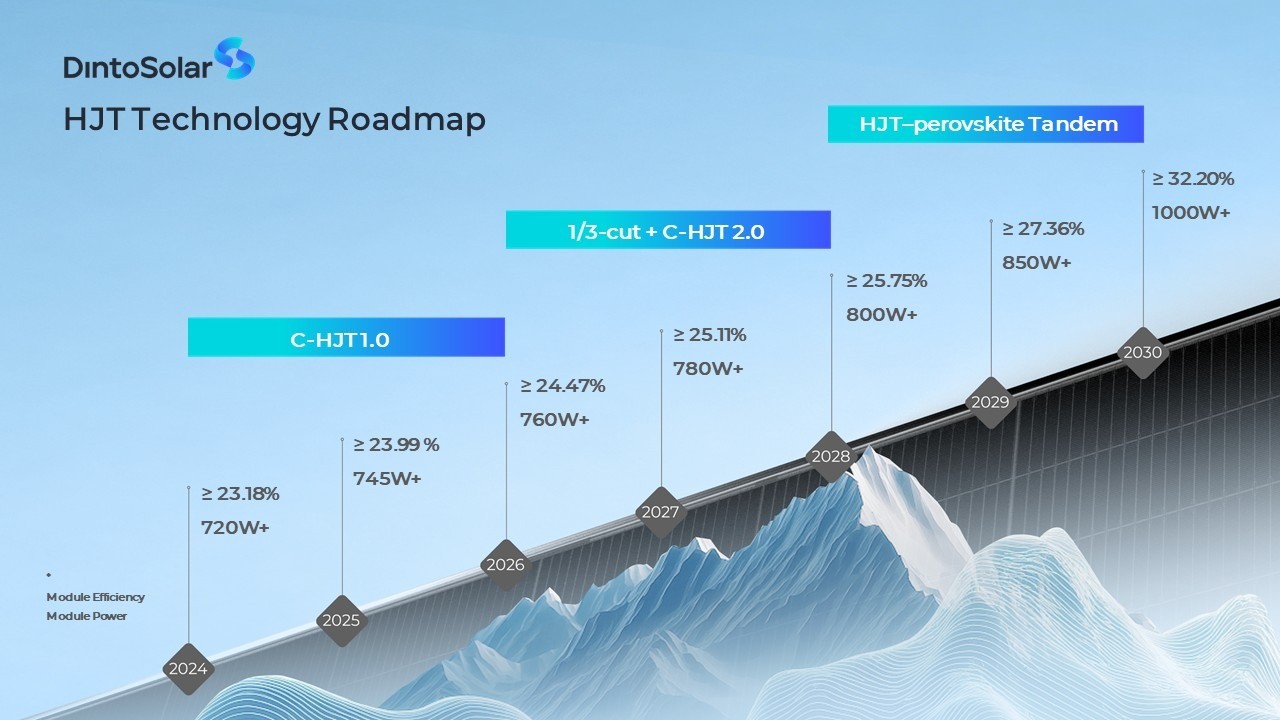
Dinto Solar’s champion module achieved over 760 W of output power with a conversion efficiency of 24.47%, setting new industry benchmarks for HJT modules. The achievement reflects years of sustained R&D investment and a full-cycle innovation system spanning fundamental research, industrialization, and forward-looking technology development.
Key breakthroughs were delivered in silver-free copper metallization, 0BB (busbar-free) designs, and ultra-thin silicon wafer integration, addressing one of the industry’s most persistent challenges: how to scale high-efficiency cells without compromising cost competitiveness or manufacturing stability. More than 30 new patent applications filed during the year underscore the depth of Dinto Solar’s technology pipeline.
With its combined advantages of high reliability, high efficiency, and improving cost structure, HJT is reshaping industry competition, accelerating the shift toward higher-efficiency, lower-energy-consumption green electricity as the market’s mainstream choice both for utility-scale and distributed PV projects.
Commercial Momentum: More Than 2 GW of Orders Signed in One Year
Technology leadership translated into strong commercial traction in 2025. Leveraging the proven reliability and performance of its HJT products, Dinto Solar entered the core supplier lists of China’s leading central and state-owned enterprises, marking a significant step in the company’s market positioning.

During the year, Dinto Solar signed over 2 GW of HJT module orders, representing more than 200% year-on-year growth. Strategic partnerships were established with major power and infrastructure groups—including State Power Investment Corporation (SPIC), China Huadian, China Energy Engineering Group, China Datang, and Shandong Hi-Speed—as well as large industrial end users such as Muyuan Foods.
Project deliveries spanned a wide range of geographies and use cases. These included a 60 MW agrivoltaic project in Wuyi, Zhejiang Province (Eastern China), a 100 MW utility-scale project in the Xinjiang Production and Construction Corps, Fifth Division (Northwestern China), a 50 MW project in the Balkans, and an 80 MW deployment in South Asia. Across domestic and international markets, more than 100 benchmark HJT projects have now been successfully delivered, validating both the scalability of the technology and Dinto Solar’s execution capability.
The simultaneous growth in orders and deliveries underscores the market’s confidence in HJT as a long-term technology choice—and positions Dinto Solar as a key driver of the industry’s shift from capacity-led expansion toward quality- and value-oriented growth.
Manufacturing Scale: 15 GW of HJT Capacity Built for Reliable Delivery
To support accelerating market demand, Dinto Solar advanced a strategically distributed manufacturing footprint with 15 GW of planned annual HJT cell and module capacity.

The company’s Longgang facility in Zhejiang Province, Eastern China, with 5 GW of capacity refined through three years of continuous operational optimization, has become a benchmark for large-scale HJT manufacturing. In parallel, construction of a 10 GW production facility in Suining, Sichuan Province, officially commenced in February 2025. Designated as a key provincial industrial project, the Suining facility further strengthens Dinto Solar’s manufacturing presence in Southwest China.
Underpinned by advanced smart-manufacturing systems and end-to-end quality control, these sites support the early large-scale application of silver-free technologies, ensuring that every order can be delivered at high quality, on schedule, and at scale.
Beyond the domestic market, Dinto Solar continued to expand its international footprint in 2025, deepening penetration across Europe, Pakistan, India, and other strategic regions. Together, these efforts form a dual-engine growth model, with domestic benchmark projects leading the way and targeted overseas market breakthroughs, reinforcing the company’s ability to serve global customers with both scale and responsiveness.
Building the HJT Ecosystem: Collaboration as a Growth Strategy
As PV manufacturing becomes increasingly specialized, Dinto Solar has emphasized ecosystem development as a strategic priority.
In 2025, the company formalized a technology partnership with GCL Integration at SNEC Shanghai, focused on joint HJT R&D and industrial application. Later in the year, a long-term strategic agreement with SoleFiori Technology Company extended cooperation across technology development, manufacturing, supply chains, and global market expansion.
These partnerships reflect a broader industry shift: innovation and cost reduction in HJT increasingly depend on coordinated progress across materials, equipment, and downstream integration.
Looking Ahead: From 25%+ Today to 30%+ Tomorrow
Often described as a “long-slope, deep-snow” industry—one that rewards long-term commitment rather than short-term gains—the photovoltaic sector favors companies with strategic discipline and sustained technological investment. Dinto Solar continues to anchor its long-term strategy on heterojunction (HJT) technology, which it regards as the most promising next-generation pathway for high-efficiency solar cells, while advancing cost reductions through wafer thinning, metallization optimization, and process improvements.

At the same time, the company is investing in HJT–perovskite tandem technologies, aiming for 30%+ conversion efficiency as the next milestone in high-performance PV.
The 2025 annual review underscores that Dinto Solar’s growth is not about incremental gains, but about deliberately shaping the next phase of high-efficiency solar manufacturing. With HJT rapidly moving to the center of the global PV market, Dinto Solar is positioning itself as both a technology leader and a long-term driver of the industry’s evolution