

















 Back to List
Dinto Solar Rolls Off First 765 W Tri‑Cut HJT Module with 24.63 % Efficiency


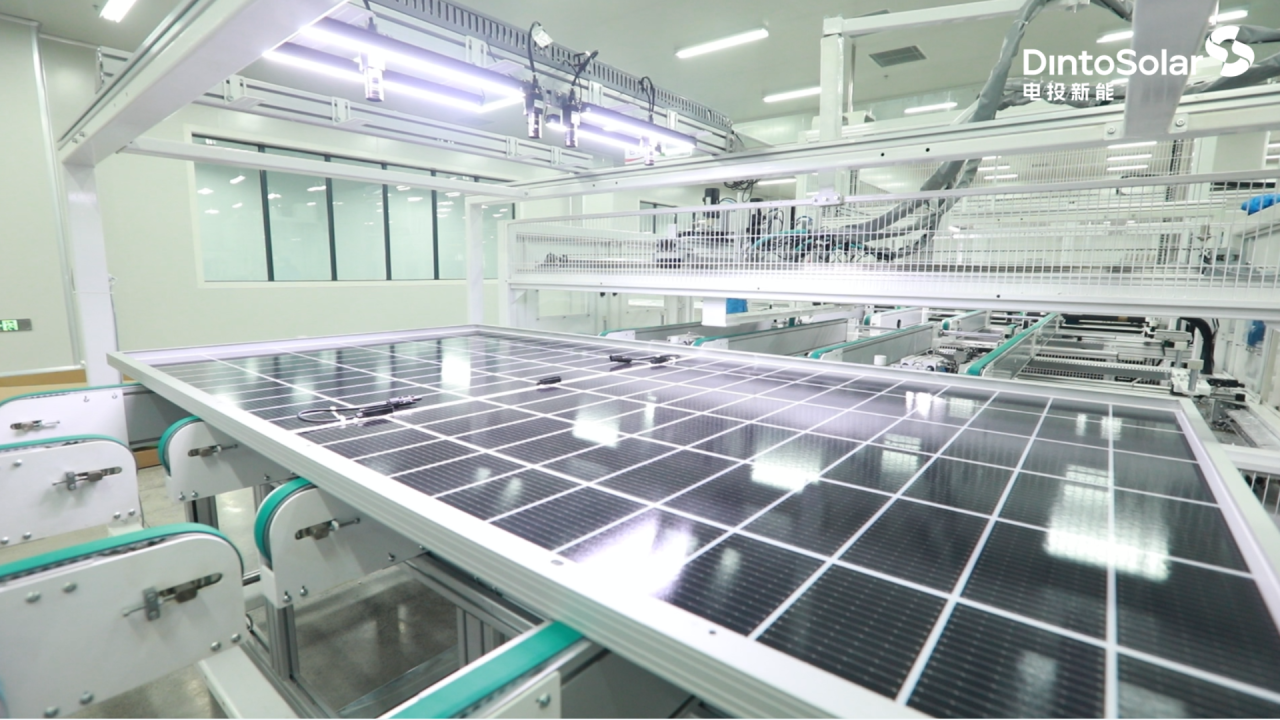
Dinto Solar has recently rolled off its first heterojunction (HJT) tri‑cut module at its Longgang manufacturing facility, achieving a peak power output of 765 W and a conversion efficiency of 24.63 %.

The module integrates multiple advanced technologies — including busbar‑free (0BB) design, tri‑cut (1/3‑cut) cell architecture, flexible interconnection, and PIB encapsulation — to deliver significant improvements in energy yield, power density, and long-term reliability. This roll‑off marks an important milestone in the company’s HJT technology roadmap and reinforces its commitment to advancing high-efficiency photovoltaic solutions under global cost-down pressures.
Around 20 W Power Gain Through Integrated 0BB and Tri‑Cut Design
The performance improvement is driven by the deep integration of 0BB and tri‑cut (1/3‑cut) technologies. Busbar‑free architecture eliminates conventional busbars and enables direct interconnection using fine fingers, significantly reducing silver consumption while lowering series resistance. The tri‑cut design divides each cell into three equal segments, reducing operating current to one‑third of a standard cell and theoretically lowering internal resistive losses to one‑ninth.

Through these combined innovations, the new modules deliver an average power gain of approximately 20 W compared with conventional half-cell modules, while improving thermal management and mitigating hotspot risks.
High Efficiency, High Yield, and Enhanced Reliability
The tri-cut technology improves current distribution, lowers resistive losses, and expands the module’s overall active light-receiving surface. With a front-side coverage ratio above 93 %, power output is improved by around 4 % compared with standard half-cell products.
On the rear side, structural optimization increases effective illumination area, enabling bifaciality up to 97 %, further enhancing backside generation, particularly in high-albedo environments. Inherent low-light response of HJT technology ensures stable output under early morning and late afternoon conditions, extending daily effective generation hours and boosting annual energy yield.
Flexible interconnection with high-elasticity materials absorbs mechanical stress and reduces microcrack formation, while PIB edge sealing provides long-term moisture resistance, ensuring durable module performance throughout its lifetime.
Strategic Technology Path and Scalable Manufacturing Focus
As wafer formats grow, increased operating current has become a key industry challenge, driving internal heating and power losses. Cell segmentation has emerged as a critical solution to balance efficiency, reliability, and manufacturability, with tri‑cut and quad‑cut approaches offering different advantages.
Dinto Solar has chosen to focus on the tri‑cut path, based on a systematic evaluation of performance potential, reliability benefits, and large-scale production feasibility, delivering solutions that are both technologically advanced and industrially scalable. Proprietary cutting and passivation processes address laser-induced damage during HJT cell processing, preserving intrinsic cell efficiency and structural integrity, and ensuring high yield consistency through downstream stringing and lamination.
Driving Lower LCOE for Utility and C&I Markets
With a peak output of 765 W and 24.63 % efficiency, the tri‑cut HJT module meets growing demand from utility-scale and premium commercial and industrial (C&I) projects for lower levelized cost of electricity (LCOE). Higher power density, improved bifacial performance, and enhanced durability reduce balance-of-system costs and maximize lifetime energy returns, supporting more competitive project economics.
The successful roll‑off highlights Dinto Solar’s long-term strategy to advance high-efficiency photovoltaic technology through continuous innovation and advanced manufacturing, while promoting large-scale deployment of HJT technology and optimizing system costs worldwide.